
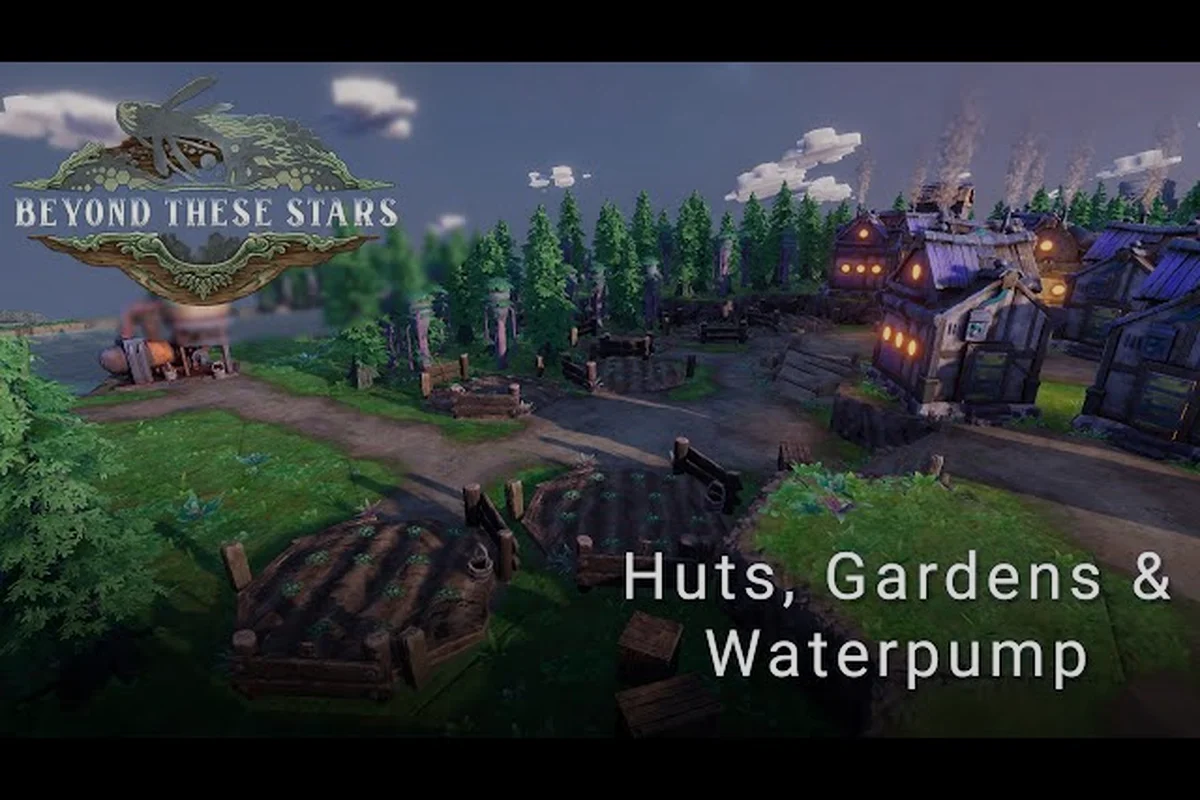
City building in Beyond These Stars starts with a Home Spaceship on the back of a living, breathing Space Whale named Kewa — and every placement decision ripples outward into happiness, sickness, pollution, and Strikes. This guide covers the verified building roster, the buildings the developer recommends placing first, how adjacency shapes efficiency, and which production chains unlock once research opens up. Because the game only launched on October 16, 2026, every number-heavy fact here is paraphrased from the the official Steam page and the Steam store page, with the gaps the developer has not yet published stated openly.
Getting Oriented: The Whale, the Peeps, and the Build Grid
Before laying a single wall, it helps to understand what you are actually building on. Kewa is a sentient giant Space Whale who carries your settlement across the galaxy, and according to the official store page, Kewa has their own health and happiness. The terrain on Kewa's back is the canvas for every base-building decision you will make in the early game. Your people, called Peeps, live in this settlement, work the buildings, fall sick, hold Strikes, gather for Celebrations, and grow in number as your colony stabilizes.
The Verified Building Roster at Launch
The developer has confirmed a specific set of structures you can place during city building in Beyond These Stars. Anything outside this list is either a future addition or a search-term invention and should be treated with caution. The table below summarizes the verified roster paraphrased from official material:
| Building | Verified Role | Key Inputs / Notes |
|---|---|---|
| Home Spaceship | Early-game hub; slowly produces starter goods | Where the first Peeps come from |
| Apothecary | Heals sick Peeps | Texture was still being finalized per Dev Blog #25 |
| Fairground | Host Celebrations when happiness is high | Dev Blog #22 confirms production/speed bonuses |
| Kitchen | Turns raw ingredients into meals | Core food production |
| Pasture | Produces Wool on planets with sheep | Cotton seeds can also be found here |
| Weaver | Converts raw fibers into fabrics | Supports Tailor downstream |
| Tailor | Produces Cold Weather and Warm Weather Clothing | Needed for survival in harsh planets |
| Tree Nursery | Plants trees; indirect Pollution reduction | Long-term biome health |
| Cleaner | Direct Pollution management | Mixes Water and Chemicals |
| Burner | Can be configured to consume Wood | Power generation with a side effect |
| Trawler | Harvests the Shell resource | Often needs water access |
| Composting | Processes Food Waste and Wood Waste | Feeds back into production loops |
| Space Port | Shuttle ships between planets | Holds up to four Landing Pads |
| Landing Pad | Required for ships to land on Kewa | Ships cannot land without one |
| Spaceship Builder | Constructs new ships | Unlocks expansion |
| Settlement Ship | Lands on new planets | Built by the story, not the player |
The Home Spaceship deserves special attention because it is both the first structure you interact with and the slowest producer you will ever rely on. It is the bridge between arriving on Kewa and having a functioning base building economy. For a deeper look at what the Home Spaceship actually produces and how to use it, the Home Spaceship guide walks through the early-game loop in detail.
Modes, Scale, and What to Expect
Two modes exist at launch: Story Mode, which the developer recommends playing first, and Sandbox Mode, which Dev Blog #27 confirms lets you choose which resources, water distribution, terrain, and planets to include. There is no multiplayer, no combat, no enemies, no bosses, no microtransactions, and no battle pass — the only progression paths are Story progression, the Research / Technology / Perks tree, and the Galaxy Map unlocking over time. Knowing that the only pressure on your base is internal (Peep happiness, Kewa's happiness, Pollution, Strikes, Celebrations) reframes how you should plan your first build.
What to Build First in Beyond These Stars
The question players ask most often is which buildings to drop on day one, and the answer depends on what your Peeps need right now rather than what looks impressive on a screenshot. According to the official Beginner's Guide linked from the release and Hotfix posts, early base building in Beyond These Stars is about stabilizing four pillars: food, health, happiness, and a path to power.
The Stabilization Priority Order
| Priority | Building | Why It Comes First |
|---|---|---|
| 1 | Kitchen | Peeps need meals to keep working; starvation triggers sickness and Strikes |
| 2 | Apothecary | Sickness chance rises as Peep energy falls each shift, so healing is preventive |
| 3 | Pasture | Secures Wool for clothing and a stable food source if planets allow |
| 4 | Tree Nursery or Cleaner | Begins addressing Pollution before it snowballs |
| 5 | Fairground | Unlocks Celebrations once happiness crosses the threshold |
| 6 | Composting | Closes the Food Waste / Wood Waste loop into fertilizer |
| 7 | Burner | Reliable early power, at the cost of Wood consumption |
The Kitchen comes first because without meals the entire economy stalls. The Apothecary follows closely because Peep sickness can spread through a settlement faster than new Peeps arrive, and Dev Blog #25 confirms that sickness probability climbs at the start of each shift as energy dips. The Pasture is the third priority because animals like Sheep and Cows create a renewable resource loop without requiring complex tech.
The Buildings You Should NOT Rush
Some structures look tempting but actually slow you down if placed too early. A Trawler requires a coastline and the Shell resource, which is rarely your first bottleneck. A Spaceship Builder is a mid-game investment because the Settlement Ship that kicks off planetary expansion is delivered by the story, not constructed by you. Landing Pads are critical — remember, ships cannot land on Kewa without one — but you only need one until you start sending multiple ships to other planets. Spreading your early-game building budget across the verified roster evenly is the most common beginner mistake, and it leaves every system underfunded.
Layout, Adjacency, and How the Grid Rewards You
Adjacency bonuses are one of the most frequently searched terms for Beyond These Stars city building, and the official material confirms they exist — but the developer has not published exact bonus values. The principle is straightforward: how close two buildings sit affects efficiency and travel time for the Peeps moving between them. This is true base building strategy, not a flavor mechanic, and it shows up in production chains, Celebrations, and even Strikes.
How Adjacency Plays Out in Practice
| Pairing | Adjacency Effect (Type-Level) | Practical Consequence |
|---|---|---|
| Kitchen near Pasture | Reduced ingredient travel time | Faster meal production |
| Apothecary near Living Quarters | Sick Peeps reach care faster | Lower death rate during outbreaks |
| Fairground near High-Density Housing | More Peeps in range trigger Celebrations | Bonuses activate sooner |
| Tree Nursery clustered with other Tree Nursery placements | Forest health compounds | Stronger indirect Pollution reduction |
| Burner near Power-Hungry Buildings | Shorter power range required | Less Pollution footprint per Watt |
| Composting near Pasture or Kitchen | Waste hauling distance shrinks | Cleaner streets, faster cycling |
Because the developer has not published a numeric adjacency table, the right approach is empirical: place a building, watch how long Peeps take to traverse the path, and adjust. The layout you finish week one will not be the layout you finish month one, and that is by design — the game rewards iteration.
Designing a Best Layout for Early Base Building
The best layout in Beyond These Stars is not a single screenshot. It is a zone-based design where each cluster of buildings has a clear purpose and clear neighbors. The three zones that matter most in the opening hours are:
-
Food Zone — Kitchen, Pasture, and any source of raw ingredients clustered tightly so Peeps do not waste shift time walking.
-
Health Zone — Apothecary near the densest housing so the Apothecary's range covers the most vulnerable Peeps.
-
Power Zone — Burner and any other power infrastructure placed upwind or away from housing, because Burner-driven power is a Pollution source and proximity matters for biome health.
This zoning approach also makes the base building experience easier to teach to new players joining a settlement, because the logic is transparent rather than dependent on hidden bonus values. For a deeper visual breakdown of how these zones interact across a larger settlement, the city layout guide expands on zoning principles and terrain considerations.
The Production Chains You Will Rely On
Beyond These Stars city building is fundamentally a production-game, and the verified resource list paraphrased from the official material defines every chain you can build. Some resources feed back into themselves (Composting turns Food Waste into fertilizer, fertilizer feeds the Pasture, the Pasture produces food), while others are one-way (Wool goes into clothing, and clothing protects Peeps on cold planets).
Verified Resources and Their Flow
| Resource | Source | Feeds Into | Notes |
|---|---|---|---|
| Wood | Trees, terrain | Burner, Construction | Renewable via Tree Nursery |
| Wood Waste | Wood processing | Composting | Byproduct, not trash |
| Food Waste | Kitchen | Composting | Closes the food loop |
| Water | Terrain, rivers | Kitchen, Cleaner, Terraforming | Terrain-dependent |
| Chemicals | Production buildings | Cleaner, Advanced Goods | Unlock via research |
| Wool | Pasture (sheep planets) | Weaver, Tailor | Cold Weather Clothing input |
| Cotton seeds | Found on planets | Weaver, Tailor | Warm Weather Clothing input |
| Shell | Trawler | Construction, trade | Needs coastline |
| Top soil | Terraforming action | Tree Nursery, planting | Used to extend forests |
| Potatoes / Soup | Kitchen outputs | Direct Peep consumption | Food stability |
| Sheep / Cows | Pasture | Wool, food | Living resources |
| Cold / Warm Weather Clothing | Tailor | Surviving harsh planets | Required for expansion |
| Advanced Goods | Research-unlocked buildings | Late-game chains | The developer has not published which buildings specifically produce these |
That last row is worth pausing on. The official material confirms Advanced Goods as a resource category gated behind research, but it does not name the building or buildings that produce them. Treat any guide that lists a "Fusion Plant" or "Hydroponics Dome" or "Research Lab" as a specific Advanced Goods producer with caution — those names appear nowhere in the verified developer material. For a complete rundown of every building the developer has confirmed, the building list guide catalogs each structure and its production role.
Strikes, Celebrations, and How Layout Affects Happiness
Two systems make layout decisions matter beyond pure efficiency. According to Dev Blog #23, the first Strike in Beyond These Stars lasts three shifts, and you receive a goal tied to the root cause of the Strike; meeting the goal can end the Strike early. Striking Peeps hold signs and physically block other Peeps, slowing movement. This means a poorly planned path between a Kitchen and a Pasture can become a Strike chokepoint.
Celebrations, confirmed in Dev Blog #22, trigger when enough Peeps in one location pass a high happiness threshold. Once active, Celebrations grant production bonuses, movement bonuses, and sickness resistance. A Fairground near a dense cluster of happy Peeps is therefore a force multiplier, not a luxury. Building a Settlement, in other words, is as much an exercise in happiness geography as it is in resource geography.
Power, Pollution, and the Biome Under Your Feet
Pollution is the most important invisible resource in base building for Beyond These Stars. Dev Blog #29 confirms that planting trees, minimizing Pollution, and creating rivers keep the biome healthy. The Cleaner building is the most direct response, mixing Water and Chemicals to scrub Pollution from the air. The Tree Nursery is the most indirect response, growing forests that absorb Pollution over time. The Burner is a Pollution source, not a sink, and its placement matters.
Pollution Management Tools at Launch
| Tool | Pollution Effect | Trade-Off |
|---|---|---|
| Cleaner | Direct, immediate reduction | Consumes Water and Chemicals |
| Tree Nursery | Slow, compounding reduction | Takes many shifts to mature |
| Terraforming (canals, rivers) | Washes Pollution out of zones | High labor cost |
| Building placement | Keeps Burners away from housing | Limits power coverage |
| Forests | Passive absorption | Must be planted, not assumed |
The Cleaner is the only verified building that explicitly mixes Water and Chemicals, which makes it a key bridge between two resource chains. If your Water economy is fragile, running multiple Cleaners can drain your reserves faster than you expect, so most players start with one Cleaner and a Tree Nursery cluster before scaling up.
Kewa Themselves Are a Layout Constraint
Because Kewa is a living entity with their own happiness, base building in Beyond These Stars is not just a static puzzle. Kewa's dialogue presents choices that nudge their happiness up or down, and a hot galaxy drags Kewa's happiness down — Dev Blog #29 confirms that if Kewa's happiness falls far enough, they begin emergency travel toward somewhere cold. That means your placement decisions, your Pollution levels, and your tech choices can indirectly dictate where your entire settlement moves next. The settlement is not anchored to a fixed coordinate; it is anchored to a creature that responds to how you build.
Expanding Beyond Kewa: Space Ports and Planetary Settlements
Once your base is stable, the next phase of city building involves reaching other planets. The verified chain is: research unlocks the Spaceship Builder, you build ships, ships shuttle between Space Ports, and a Settlement Ship lands on a new planet to establish an Outpost. Critically, the Settlement Ship is delivered by the story, not constructed by the player. You cannot just spam-build Settlement Ships the way you spam-build Pastures.
Space Port Logistics
| Component | Verified Function | Limit |
|---|---|---|
| Space Port | Shuttle hub between planets | Holds up to four Landing Pads |
| Landing Pad | Required for any ship to land on Kewa | One ship per pad at a time |
| Scout Ship | Early exploration; uses Jose as the aboard character | Investigates Galaxy Map nodes |
| Settlement Ship | Colonizes a new planet | Provided by the story progression |
| Outposts | Resource supplementation on other planets | Subject to planet conditions |
The Galaxy Map, per Dev Blog #28, is only partially visible at first and unlocks over time. Nodes on the map contain barren planets, space junk, strange objects, trade stations, and aliens — including the officially confirmed alien character Ublo, described as "infamous" and "cheeky" in Dev Blog #26. Building a Space Port with four Landing Pads early is a common power move because it lets you run multiple ship routes simultaneously once the technology unlocks. For a deeper look at how the Burner integrates with power distribution and elevates you toward the Space Port era, the Burner generator guide walks through that transition.
Frequently Asked Questions
What should I build first in Beyond These Stars?
Start with a Kitchen to secure meals, then an Apothecary to handle rising sickness, and a Pasture if you have access to a planet with sheep or cows. These three cover food, health, and a renewable resource before you invest in any infrastructure that requires research. The Home Spaceship will keep producing starter goods while you place these, so do not neglect it.
Do adjacency bonuses have published numbers?
No. The developer has confirmed that adjacency affects efficiency and travel time, but exact bonus values are not published as of the October 2026 launch. Treat adjacency as a layout principle to test empirically rather than a fixed formula to optimize. Cluster production chains together and watch how Peep movement shifts after each placement change.
How do I get more Peeps in Beyond These Stars?
Peep growth is tied to settlement stability: enough food, enough housing, low sickness, and consistent happiness all increase your population over time. The how to get more Peeps guide covers the verified population mechanics in depth, including how decorative buildings and beauty affect happiness and growth rate.
Can I build a Settlement Ship myself?
No. The Settlement Ship is delivered by story progression, not by the player. You can build a Spaceship Builder and use it for other ship types, but the first colonial vessel is part of the campaign. Plan your Outpost strategy around when the story hands you a Settlement Ship rather than trying to rush one.
What is the best layout for a new player?
A zone-based layout with a Food Zone (Kitchen + Pasture), a Health Zone (Apothecary near housing), and a Power Zone (Burner upwind) is the most reliable early-game design. This is base building 101 in Beyond These Stars, and it scales into mid-game as you add a Space Port, Landing Pads, and eventually a Settlement Ship on another planet.