
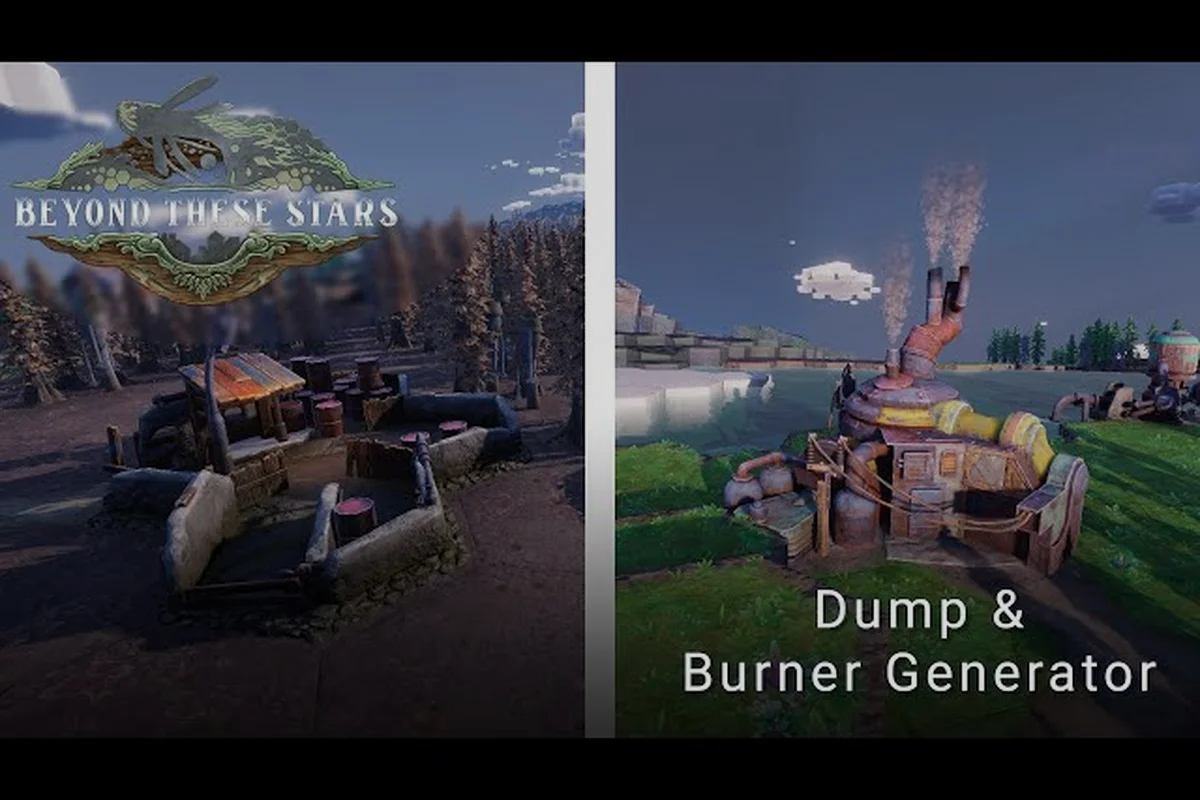
Beyond These Stars is a city builder where every production chain starts on the back of a giant Space Whale named Kewa. Resource management here is not about stacking numbers; it is about wiring raw extraction, processing, and finished goods into supply lines that survive movement across the galaxy. This logistics guide walks through how production chains are structured, how to keep your supply chain stable, and where the developer has deliberately left room for the player to discover the details. The game launched on 2026-10-16, so most of the material below comes from official developer posts and the Balancing Monkey Games on Discord listing rather than community wikis. the details. The game launched on 2026-10-16, so most of the material below comes from official developer posts and the Beyond These Stars on Steam listing rather than community wikis, and the same source-first approach is why our Beyond These Stars crafting recipes guide sticks to patch-confirmed ingredient lists instead of player-submitted guesses.
What Production Chains Mean in Beyond These Stars
A production chain in this game is the path a raw material takes from the moment it is gathered until it becomes something a Peep can use, eat, or wear. Chains can be very short — a Trawler lifts Shell straight out of a tile — or surprisingly long, with Wood going through Wood Waste, through Composting, and finally back into top soil that feeds potato farming. Understanding these chains is the foundation of every Beyond These Stars supply chain decision you will make on Kewa's back.
The Core Building Blocks
Every production chain in the game is anchored by a small set of named buildings the developer has confirmed in Dev Blogs and the official Beyond These Stars website. These are the only buildings the player can place, and each one performs a single stage of a larger chain.
| Building | Stage of Chain | Verified Resources In or Out |
|---|---|---|
| Home Spaceship | Initial slow production | Starter goods for first Peeps |
| Trawler | Extraction | Shell |
| Pasture | Extraction / animal products | Wool (Sheep), Cotton seeds |
| Burner | Processing | Consumes Wood |
| Kitchen | Processing | Ingredients → meals such as soup |
| Weaver | Processing | Raw materials → fabrics |
| Tailor | Processing | Fabrics → Cold Weather Clothing, Warm Weather Clothing |
| Cleaner | Processing | Water + Chemicals |
| Tree Nursery | Terraforming / pollution offset | Trees (indirect) |
| Composting | Recycling | Food Waste, Wood Waste → top soil |
| Apothecary | Care | Treats sick Peeps |
| Fairground | Wellbeing | Hosts Celebrations |
| Space Port | Logistics | Holds Landing Pads and ships |
| Landing Pad | Logistics | Required for any ship to land |
| Spaceship Builder | Logistics | Builds player ships |
| Settlement Ship | Expansion | Lands on a new planet (not player-built) |
The important point is that no single building closes a chain. Even a simple food chain needs the Trawler, the Kitchen, and a delivery route between them. The game's resource management is therefore inherently a logistics problem, not a building problem.
Three Categories of Resources
The developer has named a specific list of resources across the official material, and every Beyond These Stars production chain is built from them. The table below groups those resources by where they enter the chain. The developer has been explicit that stone and ore deposits are intentionally absent from the game. That single decision reshapes every supply chain decision, because there is no smelter-type processing building and no metal chain to design. What is left to route is biomass and textiles, the food chain, and the research-gated Advanced Goods category.
| Category | Resources | Where They Enter the Chain |
|---|---|---|
| Raw extracts | Wood, Shell, Wool, Cotton seeds, Sheep, Cows | Trawler, Pasture, tree tiles on Kewa's back |
| Processed goods | Wood Waste, Food Waste, fabrics, Water, Chemicals, top soil | By-products and intermediate outputs |
| Finished goods | soup, Cold Weather Clothing, Warm Weather Clothing, potatoes, Advanced Goods | Kitchen, Tailor, farming, research unlock |
Reading the In-Game Production Diagrams
The October 2026 developer update introduced in-game resource production diagrams intended to show how certain resources come to be and which buildings need them. This is the single most important tool for anyone learning the production lines in Beyond These Stars, because the diagrams are generated by the game itself rather than by a third-party wiki.
What the Diagrams Show
According to the developer, the diagrams illustrate the flow between resources and the buildings that consume or produce them. They do not show every adjacency bonus, every shift bonus, or every Peep routing decision — those are still things the player has to manage through layout. What they do show is the structural shape of each chain, which lets a new player see, at a glance, that Composting sits between Food Waste and top soil rather than between Wood and fabrics.
| Diagram Element | What It Tells the Player | What It Does Not Tell You |
|---|---|---|
| Building icon | A named production building exists for this stage | Exact throughput, cost, or worker count |
| Resource icon | A resource is involved at this stage | Per-tile yield or stack size |
| Arrow | Direction of flow between buildings | Travel time, adjacency bonus, or range |
| Building count | How many of a building are in use | Whether the placement is optimal |
Because the developer has not published building costs, resource rates, or shift durations in any official post, treat the diagrams as a map of the chain rather than a recipe book. The numbers come from your own settlement and from testing on your own map of Kewa's back.
How to Use the Diagrams for Supply Chain Planning
The diagrams work best when you treat them as a planning checklist rather than a reference. Open the diagram for any resource your settlement is running low on, then walk the chain backwards to the raw extract. If any stage is missing a building, or if the building exists but has no inputs, you have found your bottleneck. This is the simplest way to read a Beyond These Stars supply chain guide without depending on numbers that have not been published.
The Moving Forward developer post confirmed the diagrams were built as a planning aid, and the same post reworked the Before We Leave overlays so they read more clearly on Kewa's back. The overlay changes mean the information is meant to be glanced at while playing, not studied in a menu.
Building a Stable Supply Chain on Kewa
A Beyond These Stars supply chain is stable when the flow of inputs into a processing building keeps up with the demand of every downstream building that depends on it. The game does not give you a single number to optimize; it gives you a settlement you can read, and a Peep population whose happiness, health, and travel time all shape the answer.
Designing Production Lines for Early Settlement
The earliest production lines begin with the Home Spaceship, which slowly produces the goods your first Peeps need. After that, the verified early-game chain looks roughly like this: a Trawler lifts Shell, a Kitchen turns ingredients into soup, and a Burner can be set to consume Wood. None of these are theoretical — they are the named buildings the developer has confirmed. The interesting choice is not which building to place first, but how to route the Peeps between them so that the travel time does not strangle the chain.
| Early Chain Stage | Building | Common Bottleneck |
|---|---|---|
| Raw extract | Trawler, Pasture, tree tiles | No nearby processing building |
| Process | Kitchen, Burner, Cleaner | Inputs arrive from too far away |
| Recycle | Composting | Food Waste pathed past settlement edge |
| Distribute | Peep travel routes | Workers crossing the whole map |
A useful exercise is to lay out a chain so that the distance between any two stages is short enough that a Peep can complete the trip within a single shift. The developer has not published shift lengths, so the practical test is to watch your Peeps and to make sure they are not visibly idle at the end of a shift.
Managing Resource Management at Scale
Once a Beyond These Stars supply chain is working, the next challenge is keeping it working as Kewa moves between planets and the underlying terrain changes. The Galaxy Map and Solar System View both unlock after your first conversation with Kewa, and the map is only partially visible at first, unlocking over time. That means a settlement you built for one biome may need to be rebuilt for the next, and a chain that worked at the warm equator may stall when Kewa drags into a cold band of the galaxy.
The developer has confirmed that a hot galaxy drags Kewa's happiness down, and if that happiness falls far enough, Kewa starts emergency travel somewhere cold. That emergency travel is itself a supply chain event, because your Peeps have to keep eating, wearing the right clothing, and producing Advanced Goods while Kewa moves. The Tailor exists specifically so you can switch between Cold Weather Clothing and Warm Weather Clothing, which is the simplest way to insulate a production chain against temperature swings.
Resource management at scale also means balancing the verified resources against each other. The only way to get top soil is through Composting, and the only inputs Composting takes are Food Waste and Wood Waste. If your settlement produces too much clean Wood and not enough Wood Waste, your soil pipeline dries up, and the potato farming pipeline that depends on it follows shortly after. A Beyond These Stars production chain is therefore less about a single building and more about the ratio between organic waste and finished food.
Production Chains and the Galaxy Map
A production chain in this game does not end at the edge of Kewa. The Galaxy Map, partially visible at the start and unlocking over time, holds nodes that contain barren planets, space junk, strange objects, trade stations, and aliens. Some of these nodes supplement what Kewa cannot supply, and the developer refers to Outposts on nearby planets as the way to do that.
Space Ships, Landing Pads, and the Logistics Layer
The logistics layer sits on top of every production chain. Ships shuttle between Space Ports, and a Space Port can hold up to four Landing Pads, with each Landing Pad taking one ship at a time. Space Ships cannot land on Kewa without a Landing Pad, which is why a working supply chain almost always needs a Landing Pad near the busiest part of the settlement rather than on the far edge.
| Logistics Building | Capacity | What It Means for Your Chain |
|---|---|---|
| Space Port | Holds up to 4 Landing Pads | More pads = more throughput |
| Landing Pad | 1 ship at a time | Required for any ship to dock |
| Spaceship Builder | Builds player ships | Limits how fast you can expand your fleet |
| Scout Ship | Early ship, José is aboard | Used to investigate map nodes |
| Settlement Ship | Not player-built | Used to settle a new planet |
The player-built spacecraft come from the Spaceship Builder and are limited to the named ship types the developer has published. The Settlement Ship is not built by the player, which means there is a hard cap on how fast you can expand to a new planet, and that cap is set by how many Settlement Ships the developer hands you through the story. Your job is to keep the production chains behind that expansion working well enough to support it.
Outposts and Settleable Planets
Outposts sit on nearby planets and supplement what Kewa cannot supply. The Neutral Sector, mentioned in Dev Blog #28, is a named region holding a moderate-climate planet with chickens and cows — useful for diversifying the resource base beyond what Kewa's back provides. A Beyond These Stars logistics guide is not really complete without the outpost loop, because the moment a single planet cannot produce every resource you need, the supply chain has to span more than one location.
When you settle a new planet, the chain does not reset — it extends. A Peep working a Pasture on a settleable planet can still feed into the same Kitchen logic, but only if the shipping lane is reliable. That is where the Landing Pad and Space Port capacity table above becomes important: a settlement with one Landing Pad and one Space Port cannot move enough goods to support a serious outpost operation, regardless of how efficient the production lines themselves are.
Common Bottlenecks in Beyond These Stars Production Lines
Every Beyond These Stars production chain runs into the same handful of structural problems, and most of them are visible on the in-game overlay long before they become critical. The categories below come from the official systems the developer has named, not from numbers the studio has not published.
Waste, Pollution, and the Recycling Loop
The Composting building is the only verified way to convert Food Waste and Wood Waste into top soil, and top soil is the only verified input for potato farming. That makes the recycling loop a hard dependency for any settlement that wants to grow food at scale. The developer has also confirmed that pollution is a tracked system, and the Tree Nursery is an indirect way to address it, while the Cleaner (which mixes Water and Chemicals) is the more direct route.
| Pollution Lever | Building | Effect on the Chain |
|---|---|---|
| Indirect | Tree Nursery | Plants trees, slowly reduces pollution |
| Direct | Cleaner | Mixes Water and Chemicals to clean tiles |
| Preventative | Burner on Wood | Removes Wood before it becomes Wood Waste |
| Reactive | Composting | Captures Food Waste before it pollutes |
Because the developer has not published pollution thresholds or per-tile rates, the only safe way to design production lines is to keep the recycling loop active from the very start of a settlement. A settlement that lets Food Waste pile up around a Kitchen will eventually face a pollution problem that the Cleaner cannot solve alone.
Strikes, Sickness, and Peep Wellbeing
The developer has confirmed that striking Peeps hold signs and block other Peeps, slowing them down, and that the first strike lasts three shifts. A strike is therefore a logistics event, not just a happiness event, because the blocked Peeps cannot move resources along the chain. The Apothecary heals sick Peeps, and the Fairground hosts Celebrations that grant production, movement, and sickness bonuses when enough Peeps in one location pass a high happiness threshold.
The practical implication is that any Beyond These Stars production chain has to be designed to survive the loss of workers for three shifts at a time, and to recover from sickness spikes that the developer has linked to energy falling at the start of a shift. A chain that only works when every Peep is healthy is a chain that fails the moment a single strike starts.
Temperature and Clothing Swaps
The Tailor exists to make both Cold Weather Clothing and Warm Weather Clothing, and the developer has confirmed that temperature affects Kewa's happiness. A supply chain that produces the wrong clothing is a chain that wastes both Wool and Cotton seeds, and the developer has not published how much fabric each item consumes. The only safe strategy is to keep both clothing types in stock and to switch the Tailor's output as Kewa moves between temperature bands.
Frequently Asked Questions
What is a production chain in Beyond These Stars?
A production chain is the path a raw resource takes from extraction to a finished good a Peep can use. In Beyond These Stars, chains run from buildings like the Trawler and Pasture, through processing buildings like the Kitchen, Weaver, and Tailor, and end at finished items such as soup or clothing. The game includes in-game production diagrams that show the structural shape of each chain.
How do I keep my supply chain stable when Kewa moves?
Keep Composting active from the start, route the Tailor between Cold Weather Clothing and Warm Weather Clothing, and make sure each Space Port has enough Landing Pads to move goods. The developer has confirmed that a hot galaxy drags Kewa's happiness down, and the Tailor is the simplest way to insulate a settlement against temperature swings. The in-game overlay is the best tool for spotting a bottleneck before it becomes a stall.
Are there ore or metal chains in Beyond These Stars?
No. The developer has stated that the lack of stone and ore deposits is intentional, so there is no smelter-type building, no metal chain, and no alloy production line in the game. The economy runs on organics, fabrics, food, and the research-gated Advanced Goods category. Any Beyond These Stars production chain you build should assume those absent resources will never appear.
Where do Advanced Goods come from?
Advanced Goods are unlocked by research, and the developer has confirmed them as a named resource category. The studio has not published which building produces them or which resources feed into that production line, so the only safe approach is to research into the category as soon as the technology tree allows and to inspect the in-game production diagrams for the answer once the building unlocks. The diagrams added in the October 2026 update are the most reliable source for that information.
What logistics buildings do I need for a working supply chain?
A working Beyond These Stars supply chain needs at least one Space Port, one Landing Pad, and a Spaceship Builder to expand. The Space Port can hold up to four Landing Pads, and Space Ships cannot land on Kewa without a Landing Pad, so the Landing Pad is the most important piece of logistics infrastructure. Outposts on nearby planets supplement what Kewa cannot supply, and trade stations are map-node features you travel to rather than buildings you place.